
When Is Breakbulk Shipping Better for Oversized Fabricated Steel?
For oversized fabricated steel, shipping is not simply a matter of booking freight after production is complete. The transport method affects shop detailing, lifting design, protective treatment, port selection, site sequencing, and the likelihood that components arrive in usable condition. A long truss, a heavy transfer girder, a bundled column assembly, or a curved roof member may be structurally straightforward to fabricate but difficult to fit, secure, or unload through a conventional containerized route.
Breakbulk shipping is often the better choice when cargo dimensions, unit weight, handling restrictions, or construction deadlines make containerization impractical. It does not automatically mean lower freight cost. In fact, it can require more planning and closer coordination among the fabricator, freight forwarder, carrier, port, and erection team. But for the right steel package, it reduces forced disassembly, avoids repeated handling, and gives the project more control over how major components are loaded and discharged.
The decision should be made early, ideally while the steel package is still being detailed. That is where steel fabrication export packaging logistics becomes part of engineering rather than a last-minute warehouse task.
What Breakbulk Means in a Steel Construction Shipment
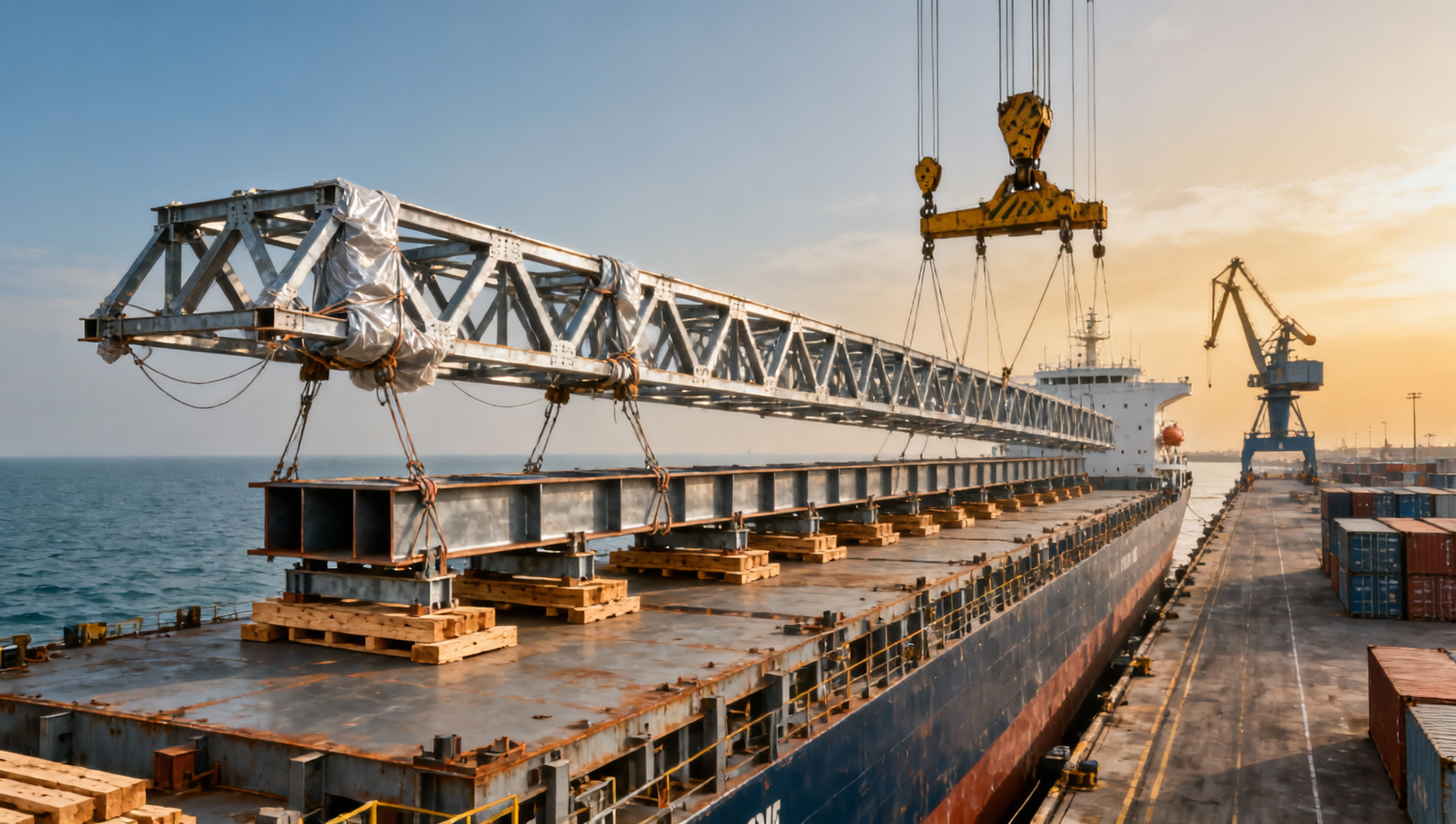
Breakbulk cargo is loaded as individual pieces or separately prepared units rather than packed inside standard shipping containers. Fabricated steel may travel as loose beams, crated connection assemblies, strapped bundles, skidded frames, or purpose-built lifting units. Depending on vessel type and port capability, cargo can be lifted by ship’s gear, shore cranes, or specialized terminal equipment and secured on deck, in holds, or on multipurpose vessels.
This differs from container shipping, where steel must fit within a container’s internal dimensions and allowable payload. Open-top and flat-rack containers extend the range of cargo that can be moved by container line, but they still impose practical constraints. An item may technically fit on a flat rack yet create complications at the terminal, exceed road transport limits after discharge, or require expensive lashing and special handling at multiple transfer points.
For fabricated steel, the central question is not merely, “Can this member be loaded into a container?” A more useful question is, “Which route allows this member to arrive with the fewest avoidable lifts, least risk of deformation or coating damage, and the clearest handover to the erection sequence?”
The Situations Where Breakbulk Has a Clear Advantage
Breakbulk becomes particularly attractive when a fabricated member is too long, too wide, too tall, or too heavy for standard equipment. This commonly applies to long-span roof trusses, plate girders, deep transfer beams, portal frames, large tubular assemblies, bridge-related steelwork, and prefabricated units that should remain assembled for quality or schedule reasons. Cutting these components into smaller sections just to satisfy container dimensions can introduce additional splices, field welding, bolted connections, inspection demands, and erection time.
Weight concentration matters as much as overall tonnage. A relatively compact steel assembly can exceed the practical payload or point-loading limits of a container floor, flat rack, truck chassis, or local handling equipment. Heavy individual pieces may be safer to load as breakbulk when their lifting points, support positions, and stowage arrangement can be designed around the actual geometry of the component.
Project sequencing is another reason to consider breakbulk. Containerized shipments are efficient when large volumes of repeatable, manageable components can be grouped and released in regular lots. A project with a few critical, oversized structural members is different. If those members govern erection progress, they may need a dedicated shipment plan, direct port handling, and visible identification that prevents them from being buried beneath less urgent cargo.
Breakbulk can also be sensible when inland destination conditions are challenging. This may seem counterintuitive because oversized cargo still needs road or rail movement after arriving at port. Yet a planned breakbulk movement can allow the logistics team to select a port with suitable cranes, storage space, customs procedures, and heavy-haul access. Forcing cargo through a container gateway that lacks a realistic out-of-gauge delivery route often shifts the problem downstream rather than solving it.

Container, Flat Rack, or Breakbulk? Compare the Whole Handling Chain
The lowest ocean freight quotation rarely provides the whole answer. A sound comparison includes fabrication changes, export packing, loading method, port charges, marine securing, customs inspection access, inland permits, and unloading at site. The option that looks economical at the port gate may become costly if it requires redesigning members, adding unnecessary field splices, or rehandling coated steel several times.
A mixed approach is common. Major girders and frame assemblies may move as breakbulk, while bolts, purlins, cladding accessories, connection plates, and smaller secondary steel travel in containers. This can preserve the benefits of container consolidation without forcing the largest components into an unsuitable format.
Packaging Is a Structural Protection Plan, Not Just a Wrapping Exercise
Export packaging for structural steel must account for more than corrosion. Cargo can be exposed to rain, salt-laden air, condensation, cargo sweat, vibration, sling contact, abrasion, and movement caused by vessel motion. Galvanized and painted surfaces need protection, but so do machined faces, bolt holes, flange edges, lifting lugs, projecting connection plates, and pre-installed items that may be difficult to replace at the destination.
The packing plan should identify where a member may be supported and lifted. Timber dunnage, saddles, separators, edge guards, and protective covers are selected around actual load paths. Improper support can cause localized distortion, especially in slender members or assemblies with exposed secondary elements. Packaging must never obstruct drainage paths or trap water against steel surfaces for an extended transit period.
Marking is equally practical. Each shipping unit should remain traceable to packing lists, erection drawings, and site sequence. Durable marks normally need to show piece identification, gross weight where relevant, center of gravity where it is not obvious, lifting instructions, and orientation warnings. Vague markings may not stop a shipment from sailing, but they can slow down an unloading crew or lead to preventable handling mistakes on a congested site.
Questions to Resolve Before Booking a Breakbulk Vessel
The booking stage should be based on a verified cargo list, not estimated dimensions from an early model. Every shipping unit should be checked for length, width, height, gross weight, lifting points, center of gravity, stackability, and sensitivity to compression. A member that can be stowed on deck may face different exposure risks from one carried under deck, and the cargo plan should reflect that distinction.
Port capability requires the same level of attention. The origin and destination terminals need suitable lifting capacity, access for trailers or heavy-haul equipment, adequate laydown space, and procedures for handling oversized steel. Customs requirements can also influence packing choices. If officials need to inspect cargo, packaging should allow reasonable access without destroying the moisture barrier or making safe re-securing impossible.
Inland movement must be planned before the vessel arrives. Road clearance, turning radii, bridge restrictions, escort requirements, travel-hour limitations, and site gate geometry can govern the maximum shippable module. The port may accept a member that the final road route cannot accommodate. In that case, breakbulk alone does not solve the issue; the shipping unit itself may need redesign or a different delivery strategy.
Common Mistakes That Create Cost After Fabrication
One recurring mistake is treating shipping dimensions as nominal drawing dimensions. Protruding stiffeners, end plates, temporary braces, lifting lugs, protective timber, and saddle height can change the actual transport envelope. Another is assuming a heavier member is automatically more robust. A fabricated assembly may have high total weight while remaining vulnerable at unsupported flange edges, cantilevered brackets, or thin-walled sections.
It is also risky to separate the erection sequence from the packing sequence. If a site needs certain columns, main rafters, or connection packages first, those items should not be loaded in a manner that makes them difficult to identify or discharge. The same applies to bolts and small fittings: a major frame delivered without its corresponding connection package can stop installation even when the primary steel is already on site.
Finally, marine lashing should not be treated as a generic carrier responsibility with no input from the fabricator. The vessel operator determines stowage and securing arrangements, but the fabricator can provide critical information about approved lifting locations, no-contact zones, support points, coating limitations, and any component that cannot be stacked or subjected to chain pressure.
Integrating Fabrication and Export Logistics Earlier
For international prefabricated building projects, the most reliable logistics decisions are made while steel detailing, cladding interfaces, and construction planning are still connected. Taisin Steel Structure Co., Ltd. works across architectural concept design, technical consulting, steel structure and cladding fabrication, component supply, and on-site construction support. That integrated scope is useful because shipping constraints can be reviewed before they become fabrication constraints.
With independent import and export rights, a Class-A qualification in steel structure design, and Grade-I certification in steel fabrication, Taisin can coordinate the engineering and export-facing details that oversized packages demand. Its membership with the American Institute of Steel Construction (AISC) and certification from the United Kingdom Accreditation Service (UKAS) also reflect an orientation toward internationally recognized requirements. For any specific project, however, the applicable drawings, contract specifications, destination rules, carrier instructions, and inspection requirements still need to be confirmed individually.
Breakbulk is the better shipping method when it protects the integrity of the fabricated steel package better than containerization, not simply when a member exceeds a container dimension. The strongest decision combines verified cargo geometry, realistic port and inland-route capability, a packaging plan tied to handling risks, and a delivery sequence that works for the construction site. If those items are reviewed before production is released, oversized steel can be shipped as a controlled project package rather than an expensive exception discovered at the dock.
We are more than happy to serve you here. If you have any question, please feel free to contact us.